![Bellini’s a proud, passionate advocate]()
by LaMara HunterKelly | May 16, 2019 | In The News
The Provider – Vol. 40 – No. 5 May 2019
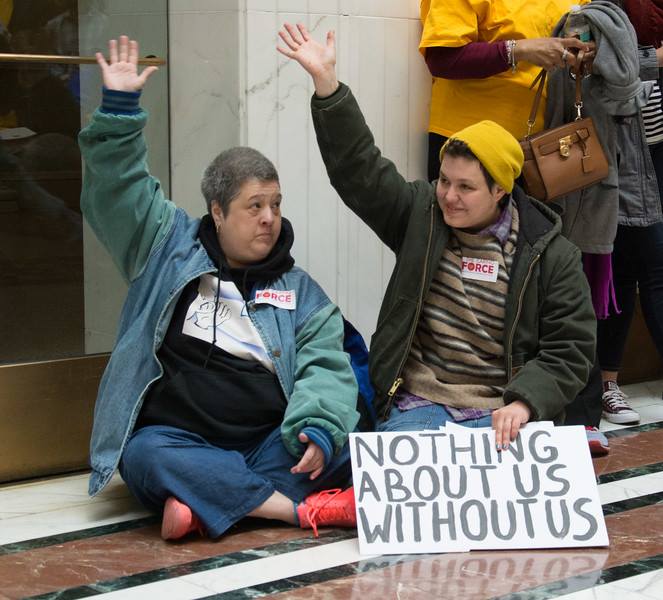
 Ness Bellini, right, and self-advocate Cassandra at the 2018 Caring Force Rally.
Bellini’s supervisor Mary Kate Farley-Dimino says “they have such a sincere style of supporting people in becoming the most effective Self Advocates they can be.” As emphasized in the Consortium’s mission, they demonstrably values the wisdom gained from “lived experience” as one of our most important resources. Bellini recognizes it “makes sense to work with people who’ve been through similar things.” “Over two years ago, self-advocates interviewing Ness knew right away they were right for the job,” said WTMC Executive Director Kristel Applebee. “The interview included an impromptu role play and Ness joined right in – it’s been an environment of curiosity for learning ever since! Ness teams with self-advocates and colleagues in an exceptional way, promoting skill development, stronger relationships and leadership that has increased impact on our service systems and community. We’re grateful for their contributions and can’t wait to see what’s next!”
by LaMara HunterKelly | May 9, 2019 | In The News
By JOSHUA SOLOMON
Staff Writer
Published: 5/9/2019
GREENFIELD —
…Advocates, like Amie Hyson, who is a recovery coach who works with The RECOVER Project in Greenfield, asked the commission to help coaches avoid burnout. This in part is to support a pay that is a livable wage and in part to provide additional services that support the coaches…
Linda Sarage, the former longtime director of The RECOVER Project, said it’s vital to increase the available training and multilingual access to them while decreasing the barriers of cost. She reminded the commission that Pittsfield and Greenfield are not necessarily close.
“We’re weeding out people from particular backgrounds and particular demographics who would be our most valuable assets,” Sarage said. “How do we make it more accessible?”
 PICTURED: Sarah Ahern
Sarah Ahern, an active member and advocate of the recovery community in town, emphasized the sheer importance of a recovery coach.
“The peer-to-peer model is so important because as a person in recovery, I’ve had way too much clinical interface,” Ahern said. “When you’re sitting across from someone who has walked your path, the trust is a little different. The trust is there right away.”
(Read Full Article HERE)
by LaMara HunterKelly | Apr 10, 2019 | In The News
 Members of Voices From Inside, including Amie Hyson, at left, who facilitates the groups at the RECOVER Project and the Franklin County jail, prepare for a public reading at the All Souls Church in Greenfield. CONTRIBUTED PHOTO
By MAX MARCUS
Staff Writer
Published: 4/10/2019 5:24:12 PM
Kayla Barcomb never wrote poetry before Voices From Inside started a writing workshop for women in the Franklin County jail last May.
So at her first writing session, even though everyone was encouraging, she only read her work aloud at the end of the session, on the last call for reading.
“I was worried about, ‘What will people think? What are they going to say? I don’t know what I’m doing,’” Barcomb said. “But after that I would go back and spend a lot more time in my cell, and I would write and write and write. Now I’ve got two folders of stuff in my backpack, and I’ve got four notebooks at home. … All of that started from Voices From Inside.”
When Barcomb was released from prison in December, she immediately started going to Voices From Inside’s group at the RECOVER Project in Greenfield.
(Continue reading…)
by LaMara HunterKelly | Jan 29, 2019 | In The News
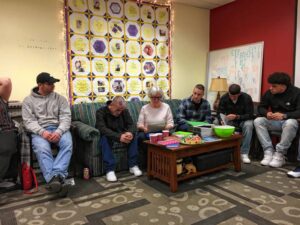 PICTURED: Judy Ryan, a retired teacher and facilitator of one of the writing groups, reads a piece by a participant, as other writers look on. She said she “got to know a group of seven courageous men who shared their experiences honestly and openly.”About 30 people took part in writing groups about how the opioid crisis has impacted their lives. The experience culminated in a reading and reception at the Northampton Recovery Center last month.
By Laurie Loisel
For the Gazette
Published: 1/29/2019 10:21:37 AM
“That is heroin. The eraser, the slate wiper. Emotional anesthetic. Love, sympathy, forgiveness, truth and beauty all in one fantastic lie. The warm embrace.”
Those powerful words are an excerpt from a piece written by Thomas Miklovich as part of a writing group for people whose lives have been impacted by the opioid crisis. I had the privilege to facilitate that four-session group in November.
Participants included parents whose adult children struggled with opioid addiction, including some who had lost the battle, as well as younger people at various stages and on various paths of recovery. Like Miklovich, they had lots to say.
Hampshire HOPE teamed up with the Academy of Music for what might seem an unlikely collaboration, resulting in a set of writing groups whose members bravely and boldly wrote about the harrowing toll opioid misuse has taken on their lives. The project aims to harness the arts to raise awareness about the opioid epidemic, possibly increasing understanding and reducing the stigma associated with the disease of addiction, which can be a barrier to people seeking help.
(Continue reading…)
by LaMara HunterKelly | Jan 25, 2019 | In The News
By JOSHUA SOLOMON
Staff Writer
Friday, January 11, 2019
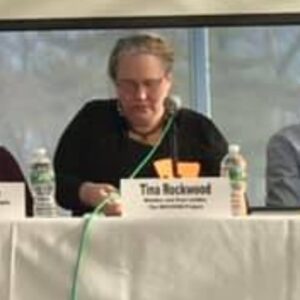
GREENFIELD — Tina Rockwood’s family often asks her when she’s getting off her medication. Sometimes they ask her if she will ever get off of it.
It’s a question she doesn’t always know how to answer, and it’s certainly one that creates some self-doubt about a form of substance use treatment that while is moving into the mainstream in America, still carries its social baggage.
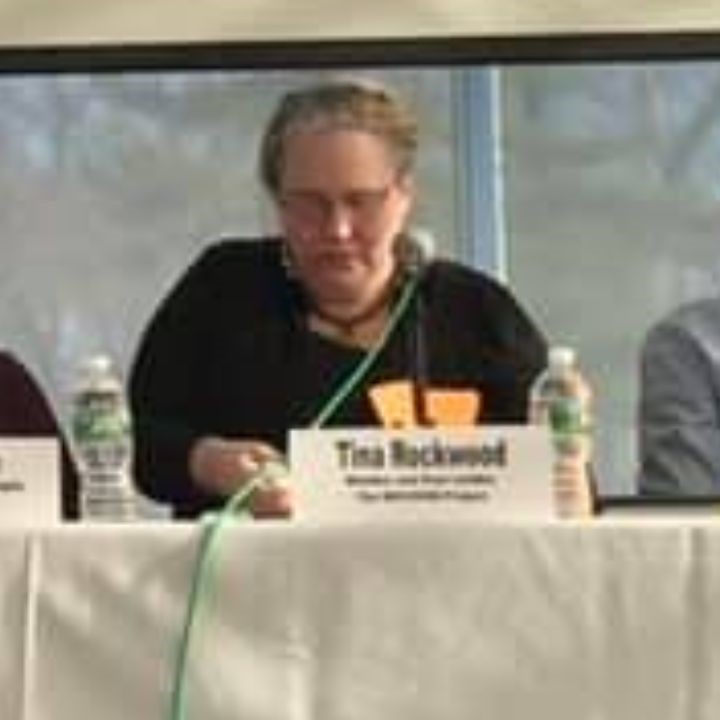
“It really affects my feelings of myself,” Rockwood (Member and Peer Leader at The RECOVER Project) told a full house of a hundred or so health providers, advocates and community members gathered at Greenfield Community College Friday morning. (Continue reading…)

by LaMara HunterKelly | Jan 7, 2019 | In The News
 “To realize that somebody else has known that dark place is the only thing that made me feel less alone.”
O-Oprah Magazine – Dec 10, 2018
The only people who really understand what it feels like to want to end their lives are those who have been there.
That’s the basis of survivor peer-support groups, in which people who have experience with suicide come together to talk.
“To realize that somebody else has known that dark place is the only thing that made me feel less alone,” says Devon Shearer, a former group facilitator at the Didi Hirsch Survivors of Suicide Attempt Support Group in Los Angeles.
Talking about the tough stuff may be exactly what suicide survivors need.
“The group is where people can share things they can’t bring up with other folks in their lives,” says Caroline Mazel-Carlton, director of training for the Western Massachusetts Recovery Learning Community and a peer facilitator for Alternatives to Suicide groups. (Continue Reading…)
NOTE from the RLC:
“On December 11th, O Magazine (the Oprah magazine) published an article called “How Talking About Suicide Can Give People Something to Live for”.
The article focuses primarily on peer-to-peer supports and groups run by and for individuals who have considered or attempted suicide. We are proud to share that the Western Mass RLC’s Director of Training, Caroline Mazel-Carlton, was interviewed for and included in the article. This is based on the fact that the RLC is responsible for creating one of the first ever models for peer-to-peer support groups related to suicide, called ‘Alternatives to Suicide’. These groups have been offered by the Western Mass RLC since 2008. The RLC has also developed an adapted ‘Alternatives to Suicide’ approach for clinicians, family, and others, as well.
Unfortunately, the article takes some of what Caroline has to say out of context, indicating that perhaps people in the group don’t actually go as deep as to talk about killing themselves. However, in reality, what Caroline was saying is that—when given the space to talk about what is truly driving people to consider leaving this planet– there are often many other things underlying that drive that they want and need to talk about, and the groups serve as a space in which they can do that.
In spite of any thing the article got wrong, it seems important that more and more mainstream media outlets are recognizing the importance of peer support in supporting people through some of their darkest times!”